One operating model, not six separate habits
Every agency already has a way of handling enquiries — it's just spread across whoever picked up the phone, whichever inbox got checked, and whatever WhatsApp thread happened to be open. Here's what replacing that with one system actually looks like.
Where work actually gets lost today
None of this is anyone's fault. It's what happens when a growing agency runs on tools that were never meant to talk to each other.
A voicemail left at 6pm sits until someone happens to check it the next morning — if they remember which line it came in on.
A tenant emails about a repair, then WhatsApps the same thing an hour later. Now there are two records of one problem, and neither has the full picture.
Cover for a colleague on leave means covering their inbox too — and hoping nothing they were quietly tracking drops.
The operational layer underneath your existing tools
Cerberus doesn't replace your phone system or your email. It sits underneath both — live today on Voice and Email — so that however a tenant, landlord or contractor gets in touch, the same thing happens next: the enquiry becomes a case, the case has one record, and that record is what everyone — including Cerberus — works from.
That's what makes it an operational layer, not a chatbot.A chatbot answers one conversation. Cerberus runs the whole process behind it — receiving the contact, understanding it, coordinating landlord and contractor involvement where needed, and keeping it tracked until it's actually resolved.
Not smarter replies. Not another dashboard to check. One continuous journey from first contact to resolution, so nothing depends on which inbox someone happened to be looking at.
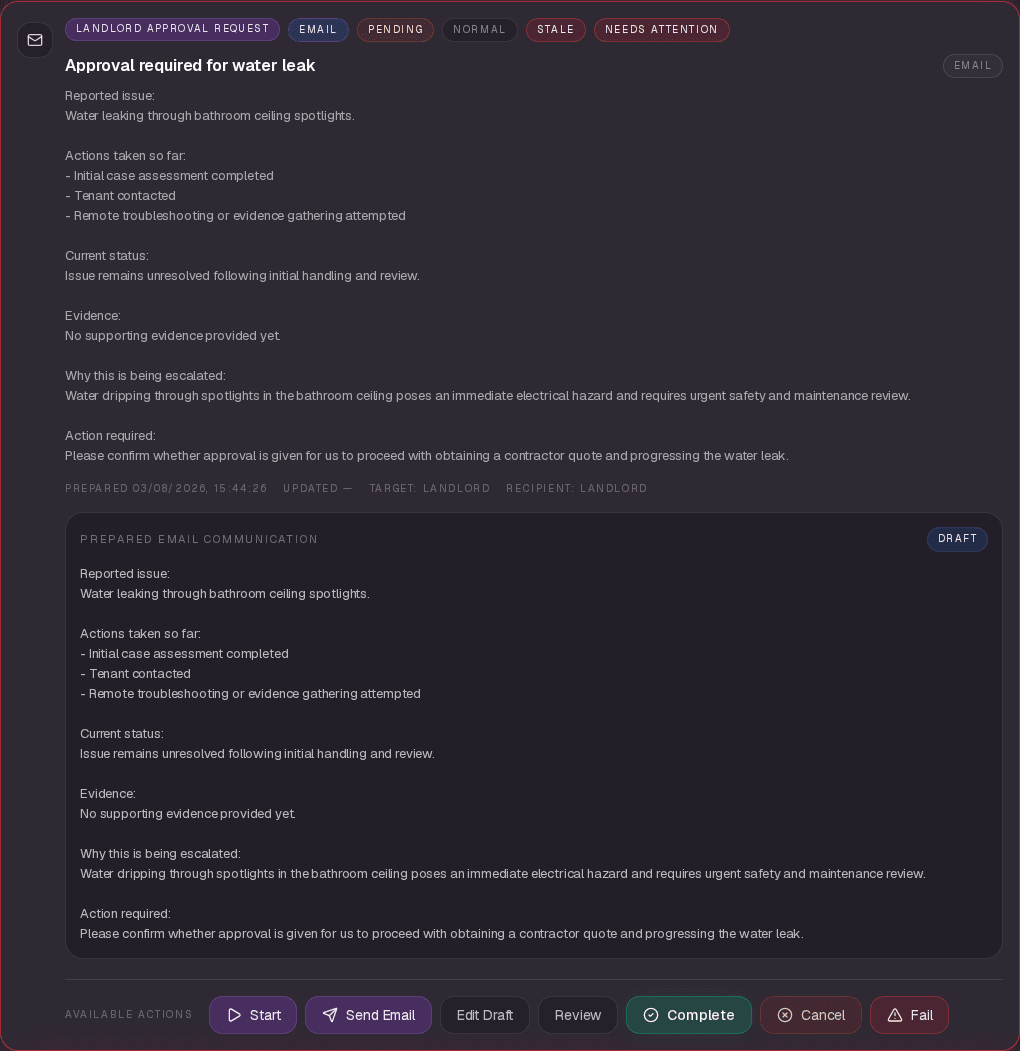
Prepared for your team, not sent by Cerberus
Cerberus drafts the landlord approval request, the contractor instruction, the tenant update — every time, ready to review. Nothing here was sent until someone on the team chose to send it.
How a case moves through Cerberus
The same six stages, however the enquiry started.
- 01ContactA call or an email comes in. Cerberus receives it immediately — nothing waits for someone to open an inbox.
- 02UnderstandCerberus works out what's being asked and checks it against the property and tenancy record.
- 03DecideCerberus prepares what should happen next — a reply, an update, or an escalation — ready for a person to review.
- 04CoordinateWhere a landlord's authority or a contractor's involvement is needed, Cerberus prepares that too — routed to the right person, in context.
- 05UpdateNothing goes out — no reply, no update, no instruction to a contractor — without a member of your team reviewing and approving it first.
- 06CloseThe case stays visible until it's actually resolved, not just until someone stops thinking about it.
One event can become the next operational process
An inspection isn't finished just because somebody attended the property. If it identifies something that needs action, Cerberus can carry that finding directly into the next operational process — preserving the case context as authority, contractor action, escalation or follow-up becomes necessary.
What doesn't change
However the product grows, three things stay fixed.
Nothing is sent to a tenant, landlord or contractor without a person approving it first.
Every case has exactly one record — not a version in email, another in WhatsApp, and a third in someone's memory.
You can always see what Cerberus has done and why, in plain language — not a log file.
See the operating model against a real case
We'll walk through an actual enquiry end to end, on a call with our team.
See Cerberus in Action